Technical reference
Drilling & Sampling
Boreholes, sampling, in-situ tests, and bearing capacity — core methods for subsurface investigation.
- 10 tests documented
-
Drilling and sampling
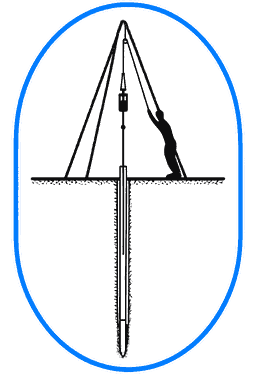
Drilling and sampling is a geotechnical investigation method used to extract soil or rock samples from the subsurface to determine their engineering, geological, and environmental properties. This process involves boring holes (drilling) and collecting materials (sampling) for laboratory testing, crucial for evaluating site strength, contamination, and design parameters.
-
Soil boring
Soil boring is a geotechnical drilling process that extracts subsurface soil and rock samples to analyse soil layers, strength, and composition. It is essential for determining foundation requirements, assessing groundwater levels, and evaluating site suitability for construction. These samples are analysed for structural design and environmental assessment.
-
Core drilling
Core drilling is a specialised rotary drilling technique that uses a hollow, diamond-tipped or carbide bit to cut a perfectly cylindrical hole, extracting a solid “core” sample of material rather than grinding it into dust.
-
Standard Penetration Test (SPT)
The Standard Penetration Test (SPT) is a common in-situ geotechnical field test used to determine the density, strength, and bearing capacity of soil by driving a split-spoon sampler into the ground.
-
Auger boring
The auger boring method of soil exploration involves rotating a helical screw (auger) into the ground to create shallow to moderate-depth boreholes, primarily in soft to stiff cohesive soils above the water table. It is a fast, economical, and popular method for collecting disturbed soil samples. Hand-operated augers reach depths up to 6 m.
-
Disturbed and undisturbed samples
Collecting disturbed and undisturbed soil samples is a fundamental aspect of geotechnical engineering investigations, designed to assess the engineering properties of soil layers at different depths for construction design. Disturbed samples are used to classify soil and identify its grain properties, while undisturbed samples are critical for determining the in-situ structure, strength, and settlement behaviour of the soil.
-
Safe Bearing Capacity (SBC)
Safe Bearing Capacity (SBC) is the maximum pressure a soil can safely withstand without experiencing shear failure or excessive settlement. It is a critical geotechnical parameter, calculated by dividing the ultimate bearing capacity by a factor of safety.
-
Dynamic Cone Penetration Test (DCPT)
The Dynamic Cone Penetration Test (DCPT) is a rapid, in-situ geotechnical test used to evaluate the strength and consistency of soil layers and compacted materials.
-
Cone Penetration Test (CPT)
The Cone Penetration Test (CPT) is a widely used, rapid, and accurate in-situ geotechnical method for determining subsurface soil conditions and properties.
-
Trial pits
A trial pit (or test pit) is a shallow, excavated hole — typically 1–5 metres deep — used to directly observe, sample, and log subsurface soil, rock, and groundwater conditions before construction.
Related services
Soil Testing for Construction in Chennai
Borehole investigation, sampling, and laboratory analysis that establish safe bearing capacity and foundation requirements before you build.
View details →Pile Foundation in Chennai
Foundation design and construction supervision — from soil investigation through pile specification, load test verification, and quality assurance.
View details →Plate Load Test
In-situ determination of bearing capacity and settlement behaviour by loading a plate at foundation level.
View details →